top of page

All Posts

Updated: Nov 19, 2024

Golden Gate Park, San Francisco, CA.


Image 1


Verse 7

 1)       At stone wall’s door

2)       The air smells sweet

3)       Not far away

4)       High posts are three

5)       Education and Justice

6)       For all to see

7)       Sounds from the sky

8)       Near ace is high

9)       Running north, but first across

10)   In jewel’s direction

11)   Is an object

12)   Of Twain’s attention

13)   Giant pole

14)   Giant step

15)   To the place

16)   The casque is kept.


1)       At stone wall’s door

2)       The air smells sweet

This refers to Shakespeare Garden in Golden Gate Park, San Francisco, California.  The shape of the brickwork around the bust of Shakespeare matches the stone shapes at the top of the painting (see photo below left and image below right), which is only a few hundred feet from the Garden of Fragrance.  Both Shakespeare Garden and Garden of Fragrance are about ½ mile east of the treasure’s location.


Shakespeare Garden                                        Top of the painting


3)       Not far away

4)       High posts are three

Most people think that “three” refers to the quantity of “posts” and that this clue refers to the Sutro Tower just outside the park (see photo below left).  But approximately ½ mile west of the treasure was The Goddess of the Forest, a redwood sculpture that has since been moved (see photo below right).  Byron would occasionally begin a clue with a hint to its answer, which is precisely what he did here.  That hint being “High”.  “three” refers not to the quantity of posts, but rather to their height.  This sculpture was commonly described as three stories high, hence the mention of “High” at the beginning of the clue.  This is further confirmed by the fact that, in the hints that Byron provided for the Japanese version of the book, he not only referred to the high post in a singular context, he stated that it was made of wood.


Sutro Tower                                      The Goddess of the Forest


5)       Education and Justice

6)       For all to see

This is a reference to the California Academy of Sciences, which is immediately adjacent to Shakespeare Garden.


7)       Sounds from the sky

8)       Near ace is high

This refers to the noise emanating from the State Route 1 (SR-1) overpass, and that you are beneath it.


9)       Running north, but first across

With a clever play on words Byron speaks of both a highway and a large religious symbol.  SR-1 does run north, but it cuts across to the east before returning to the north, hence the phrase “but first across.”


Also, just before it cuts across to the east, there is a very large religious cross, again lending itself to the phrase “but first a-cross” (see photo below left and map below right).


Prayerbook Cross                         SR-1 crossing Golden Gate Park


But this clue also hints at where the treasure is buried.  Byron could have said “Running south, but first across” or “Running north and south, but first across.”  But he didn’t.  He chose to mention only north.  He directs the reader to beneath the northbound lanes of the only SR-1 overpass in the park, a very specific location (see photo below).


Northbound side of SR-1 overpass in Golden Gate Park


10)   In jewel’s direction

11)   Is an object

12)   Of Twain’s attention

Mark Twain wrote a lot about religion.  This clue refers to the pearl in the painting, the jewel for this puzzle, which appears to be floating around the woman’s neck where many people wear a cross (see photo below).  The clue being, now that you are beneath the northbound lanes of the SR-1 overpass, you need to look in the direction of the cross (Prayerbook Cross), toward the northeast.


Painting with floating pearl where cross would be


Looking northeast under the northbound lanes of the SR-1 overpass


13)   Giant pole

14)   Giant step

15)   To the place

16)   The casque is kept.

When most of us hear the phrase “Giant pole” we think of a long large-diameter solid wooden cylinder.  But by definition it doesn’t have to be long, round, or wooden.  This is the kind of specific knowledge that Byron occasionally used to hide things in plain sight.  The reason this treasure hasn’t been found is that, when people get to the SR-1 overpass, there is nothing that resembles a conventional pole.  There is, however, a “Giant pole” made of concrete with a rectangular cross-section (see photos above and below).  As you travel north (left in the photo below) from the “Giant pole”, you encounter a small stream, which requires a “Giant step” to cross it, to get “To the place The casque is kept.”  This tells you that the treasure is buried in the small strip of land between the stream and the overpass abutment to the far left.


Beneath the northbound lanes of the SR-1 overpass, facing east


In the painting (below left), notice that there are two columns of rectangles on the woman’s sleeve, and that her forefinger is pointing downward just below the third rectangle in the left column.  In the photo (below right), notice that the concrete wall directly across from the giant pole has two columns of three rectangles each.


Two columns of three rectangles on sleeve     Two columns of three rectangles on wall


Also in the painting (above left), there is a yin-yang symbol close to where the woman is pointing.  This symbol is often interpreted to represent a balance, such as hard and soft, dry and wet, or rock and water, all of which are present at this location (see photo above right).


A little farther down that same narrow panel in the woman’s robe is what appears to be an upside-down roman numeral IV (see image below left), as if it was laid down in front of you.  This is meant to represent the horizontal distance from the wall, outward, to where the treasure is buried (see photo below right).  The caveat being, roman numerals do not have fractions, so this could mean anywhere between four and five feet from the concrete wall.


Upside-down roman numeral IV                        Horizontal distance from wall


Flower with no vase                 Pearl stick pin beside black hole Actual stick pin


When flowers are displayed on a table they are almost always in a vase.  Note that the flower in this painting is only supported by its stem, which simply disappears into a black hole beneath the table (see image above left).


Toward the bottom and just to the right of that black hole is a pearl stick pin (see image above center and photo above right).  This is to indicate that the treasure is at the bottom of the same hole the plant is growing out of.


At this point it’s worth remembering that Byron loved to use history in his puzzles.  Perhaps the most remarkable fact about the Golden Gate Park is that more than 100 years ago they planted more than 155,000 trees to create it.  Likely as a tribute to those early visionaries, Byron planted a young seedling in the same hole he buried the treasure, which can now be seen growing IV feet from the concrete abutment that has two columns of three rectangles each.  Bringing a small plant with him was the perfect pretext for carrying a shovel and digging a hole.


Current Status of the San Francisco Treasure


The San Francisco casque is still exactly where Byron buried it.  Over the last 40-plus years, however, a complication has grown.


This is one of two puzzles where Byron planted a seedling in the same hole he buried the treasure, to delineate its precise location.  The casque could be found from the other clues, but the plant provides its most accurate location.


Today that small plant (believed to be a mirror bush) has grown considerably and, in its search for sunlight,  now reaches out from under the overpass.  The complication being that it is now cantilevered and any digging around its roots could risk it falling over.  If the park will permit digging in the vicinity of this plant’s roots, the two best ways of dealing with this cantilever are:

  1. Take this opportunity to relocate this plant to a more prominent location with a better growing environment, and perhaps dedicate it to Byron with a plaque at its base.

  2. If it is to be left in place, support the plant with an X-brace (as shown below) while digging (perhaps with an AirSpade).


Cantilevered plant growing out from beneath overpass


Updated: Nov 19, 2024

Parc du Faubourg-Sainte-Anne, Griffintown, Montreal, QC.


Image 9


Verse 5

 1)       Lane

2)       Two twenty two

3)       You’ll see an arc of lights

4)       Weight and roots extended

5)       Together saved the site

6)       Of granite walls

7)       Wind swept halls

8)       Citadel in the night

9)       A wingless bird ascended

10)   Born of ancient dreams of flight

11)   Beneath the only standing member

12)   Of a forest

13)   To the south

14)   White stone closest

15)   At twelve paces

16)   From the west side

17)   Get permission

18)   To dig out.


A great many of Byron’s clues have multiple meanings.  Often, one referred to a prominent local venue that he thought was worth experiencing, and the other took you closer to the treasure.  This is precisely the case with the first three clues in Verse 5.


1)       Lane

The first reference of this clue is to Montreal’s Formula 1 racetrack, Circuit Gilles Villeneuve, on Notre Dame Island about a mile northeast of Griffintown (see photo below).  The racetrack was completed in 1978 just a few years prior to Byron’s visit.  Its shape can be seen in the outline of the man’s smile in the painting.


Griffintown and Circuit Gilles Villeneuve


The second reference is to a street that passes just a few feet from the treasure.  The connection here can be found in the definition of lane, a narrow road.  Parc du Faubourg-Sainte-Anne (St. Ann’s Park) in Griffintown is triangular in shape and bounded by three streets.  But only the street on its southwest side, Rue Rioux, is one-way and thereby narrower than the other two (see photo below).


Parc du Faubourg-Sainte-Anne (St. Ann’s Park) in Griffintown


Note that in the northeast corner of the park you can still see the granite foundation of St. Anne’s Church, for which the park is named.


2)       Two twenty two

This clue builds on the two things referenced in the first clue.


222 Circuit Gilles Villeneuve is the address of the abovementioned Formula 1 racetrack.


Also, when measured along Rue Rioux from the street sign that bears its name, in the direction of its (one-way) traffic, “Two [hundred] twenty two” [feet] is the exact distance to where the treasure is buried (see photos below left and right).


But several things have changed in the last few years.  There used to be a kind of multipurpose utility pole at the northwest end of Rue Rioux, which held a street sign bearing its name (see photo of old pole below left).  Now, the one-way traffic has been rerouted in the opposite direction and that street sign has been moved.  But when Byron was there, 222 feet measured from the old street sign in the old direction of traffic was where you would find the next clue, “You’ll see an arc of lights”.  It’s difficult to discern in the photo, but the location of the street sign can be determined by the shadow of the pole to which it was attached (see photo below right).


Old street sign location                                  222-foot measurement from street sign 


3)       You’ll see an arc of lights

While there may also be an arc of lights that can be seen from the racetrack, this clue most certainly refers to the arc of light-colored granite stones that are located in St. Ann’s Park just a few feet from the abovementioned “Lane” and “Two [hundred] twenty two” [feet] from the sign that bears its name (see photo above right).


4)       Weight and roots extended

5)       Together saved the site

6)       Of granite walls

These lines refer to the “Weight and roots” of the Griffintown community, who “Together saved the site Of granite walls” of the St. Ann’s Church, which can still be seen in the northeast corner of the park.


7)       Wind swept halls

This clue is another reference to Notre Dame Island, which was the site of the 1967 World’s Fair and the 1976 Summer Olympics’ rowing and canoeing.  Notice both the numbers 67 and 76 in the flower in the painting (see image below).  Though the site remained open to the public in the summertime until 1984, by the time Byron arrived in 1981/82 many of the pavilions had deteriorated and were abandoned, hence the “Wind swept halls”.


Flower with 67 & 76


8)       Citadel in the night

This refers to the Salvation Army Citadel, which provided shelter to those in need day or night.  It was located in the Golden Square Mile area (see photo below) of Montreal from 1948-2007, less than a mile northwest of St. Ann’s Park.  It was also just a few hundred feet from the George Stephen House, which is where you can find the ‘leg-eater-dog’ shown in the painting.


Golden Square Mile Area


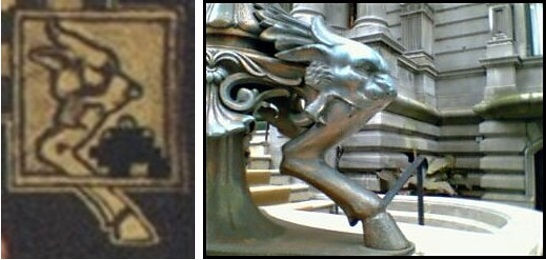
Leg-eater-dog in painting          Leg-eater-dog lamp base at George Stephen House


9)       A wingless bird ascended

10)   Born of ancient dreams of flight

This refers to Canada’s first ever passenger flight, which was conducted on Sep. 8, 1856, by a hot-air balloon called Canada.  It took off from Griffintown just a few hundred yards north of present-day St. Ann’s Park.


11)   Beneath the only standing member

12)   Of a forest

This clue is classic Byron.  He used his literary expertise to take advantage of our natural propensity to misread what is written.  Upon reading this clue virtually everyone envisions a sole surviving tree where a forest once stood.  But that’s not what it says.  It doesn’t say ‘the only member still standing’; it says “the only standing member”.  While shrubs, vines, grasses, and mosses are all members of a forest, the only such member that is commonly referred to as standing is a tree.  The treasure is buried beneath a tree.


13)   To the south

Like many other lines in Byron's puzzles, this line is applicable to both the clues above it and below it.  The tree beneath which the treasure is buried is south of where the hot-air balloon Canada took off.  And the “White stone” is not only south of that tree, but the southernmost of the four white stones (see photo below).


14)   White stone closest

15)   At twelve paces

16)   From the west side

When Byron used the terms “paces” or “steps”, he used them not as a means of exact measurement, but rather as an approximate distance to a particular object, which in turn would define the exact location of the treasure.  Byron equated the terms “paces” and “steps” to the generally accepted approximate distance of 2.5 feet (30 inches).  In this case, “twelve paces”, or approximately 30 feet, brought you to a “White stone”, which revealed the location of the treasure.


Byron refers “To the south White stone closest At twelve paces From the west side”.  The question is from the west side of what?  This is another of Byron’s multi-clues.  It refers to both the west side of the park and to the west side of closest white stone.  The photo below is what it looked like when Byron was there.  Notice that there is no sidewalk, just a dirt path in the park alongside the curb, which means that Byron would have measured those “twelve paces” (30’) from the concrete curb, to the west side of the southernmost white stone (see photo below, which was taken facing north).


Arc of light-colored stones 12 paces from the west side of the park, 222 feet from Rue Rioux street sign


Among the things that have recently changed is a new 7.5’ wide sidewalk (see photos below).  Fortunately, the four light-colored stones (to the right in these photos) and the utility pole (to the left in these photos) were not moved.  Which makes it possible to still take accurate measurements.  The new sidewalk encroaches 2.5’ (1 pace) into the park and 5’ into the street, which can best be seen at the base of the utility pole in the photos below.  Now, the south white stone “From the west side” [of the park] has been reduced from 30’ to 27.5’ (from 12 paces to 11 paces).


Before sidewalk


After sidewalk


17)   Get permission

18)   To dig out.

On the surface this clue appears to be of little consequence.  But it’s safe to say that none of Byron’s clues were purposeless.  This is the only puzzle in which Byron mentions getting permission to dig.  Also, if you wanted to remind people to get such permission, the most likely wording (in descending order) would be:

a)     Get permission to dig

b)    Get permission to dig up

c)     Get permission to dig out

Intrinsic to this last clue is the question ‘out from where?’  The most likely answer is out from between the two most southern white stones.  This location is on the west side of the southernmost white stone.  Notice the gap between the last two stones (lower left photo) and how the jewel in the painting is located between the last two of four light-colored rectangles in a diagonal row on the man’s hat (lower right image).  As is often the case, the last few lines of the verse delineate the precise location of the treasure.


Arc of light-colored (granite) stones                   Jewel tucked in between lower two rectangles on hat 


Current Status of the Montreal Treasure


The Montreal casque is still exactly where Byron buried it.  The possible difficulty being he may have buried it three to three and a half feet down. In the book Byron states that the casques are buried at a depth of no more than three to three and a half feet.  Which begs the question why would any casque need to be buried so deep?  The Montreal casque may answer that question. If there's one thing we've learned about Byron and his puzzles, it's that there isn't much he didn't think of. Byron may have buried the Montreal casque deeper than all the others out of concern for the ground freezing and crushing the plexiglass box.


Updated: Nov 19, 2024

Ponce de Leon’s Fountain of Youth Archaeological Park, St. Augustine, FL.


Image 6


Verse 9

 1)       The first chapter

2)       Written in water

3)       Near men

4)       With wind rose

5)       Behind bending branches

6)       And a green picket fence

7)       At the base of a tall tree

8)       You can still hear the honking

9)       Shell, limestone, silver, salt

10)   Stars move by day

11)   Sails pass by night

12)   Even in darkness

13)   Like moonlight in teardrops

14)   Over the tall grass

15)   Years pass, rain falls.


Ponce de Leon’s Fountain of Youth Archaeological Park Map (north is to the left)


1)       The first chapter

2)       Written in water

When Byron was there, the words “The first chapter” were on the sign at the entrance to the Ponce de Leon’s Fountain of Youth Archaeological Park in St. Augustine, Florida (1 on the Park Map above).  At that time there was also a small building that served as a welcoming center, which had a mural of North America painted on one of the inside walls.  The words “The First Chapter” also appeared in that mural where the Gulf of Mexico would be, hence the second line “Written in Water”.


3)       Near men

4)       With wind rose

Currently, there is a wind rose (below right) on display as you enter the Navigator’s Planetarium building (4 on the Park Map above).  But when Byron was there the wind rose was being displayed on the east side of the bathroom building (31 on the Park Map above), near the local attraction brochures (see photo below left).  The “men” in this clue refers to the ‘MEN’ sign outside the bathroom, which was inches from the wind rose, and only about 20 feet from the treasure.


Old display area of wind rose                          Wind rose 


5)       Behind bending branches

If Byron was good at anything, he was a master at creating clues that could be used in multiple ways.  This clue can be used with the two lines above it, and the two lines below it.


Directly behind this bathroom building with the ‘MEN’ sign and where the wind rose was being displayed is Magnolia Ave., the street from which you enter the park.  “Behind bending branches” refers to the oak trees that line this street with their bent branches creating a canopy over it (see photo below).  Both the “men” and the “wind rose” were just “Behind bending branches”.


Bending branches along Magnolia Ave. (Park behind wall to left)


3)       Near men

4)       With wind rose

5)       Behind bending branches

6)       And a green picket fence

7)       At the base of a tall tree

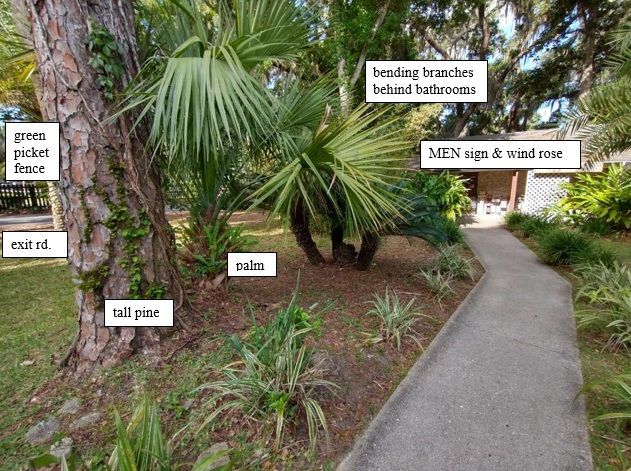
While lines 1 and 2 affirm that you are in the right place, lines 3 through 7 all speak to the location of the treasure.  The “men” sign, “wind rose”, “bending branches”, and “a green picket fence”, are all near “the base of a tall tree” where the treasure is buried (see photo below).


Though the “green picket fence” is not labeled on the Park Map, it runs along the south side of the Park Exit (32 on the Park Map above) and can be seen at the left edge of the photo below.


Mystery writers often subtly introduce important elements of their story early, so that the reader will recall them later, and solve the mystery.  Byron introduces the “green picket fence” here so that the reader will later recognize it when he refers to it symbolically as “the tall grass”.


7)       At the base of a tall tree

This clue might not seem very helpful since there are many tall trees in the area.  But later in the verse Byron provides a clue that singles out the exact tall tree.


Tall (pine) tree with MEN sign, wind rose, bending branches, & green picket fence nearby


8)       You can still hear the honking

This clue refers to a bevy of swans that once lived in the park.  Sadly, shortly before Byron’s visit the swans were killed by a pack of wild dogs that roamed the marsh.  Because the swans were loved by visitors, the story got significant coverage in the local news.


9)       Shell, limestone, silver, salt

There is a prominent shell and limestone wall between the abovementioned bathroom building and Magnolia Ave., which the “green picket fence” adjoins (see photo below).


Shell & limestone wall behind bathroom, with adjoining green picket fence


Also, a “silver, salt” cellar (salt shaker) is perhaps the most notable artifact recovered from this site, with a replica on display in the Spring House just east of the “tall tree” (see photo below).


Silver salt cellar

 10)   Stars move by day

11)   Sails pass by night

These lines refer to the Navigator’s Planetarium building (4 on the Park Map above) where demonstrations are given on how early mariners used the stars to sail at night.  Byron introduces the Planetarium building here so that the reader will recognize it a few lines later, when he uses its dome to simulate “moonlight”.


12)   Even in darkness

This clue calls attention to the fact that the next clue is valid “Even in darkness”.


13)   Like moonlight in teardrops

14)   Over the tall grass

The fact that he starts this clue with “Like” tells us that it’s not about “moonlight,” “teardrops,” or “tall grass,” but rather things that simulate moonlight, resemble teardrops, and symbolize tall grass.  The spherical white dome atop the planetarium simulates moonlight, the water droplets of the fountain resemble teardrops, and the green picket fence (behind you in the photo below) symbolizes tall grass.  What’s more, this clue necessitates that you be north of the green picket fence to view “moonlight in teardrops Over the tall grass”, which narrows down where the tall tree and the treasure can be.


15)   Years pass, rain falls.

This again refers to the hourglass-shaped fountain (see photo below).


Hourglass-shaped fountain with planetarium dome in the background (picture was taken with green picket fence behind you, when the fountain was not in operation)


Notice that Byron said “Over the tall grass", not 'on' the tall grass.  Even in darkness, the moon-like planetarium dome lines up with the hourglass-shaped fountain, to create a vector that passes over the green picket fence and near "the base of a tall tree" (see photos above and below).


Regarding which "tall tree", this is one of three clues that have baffled most.  A second baffling clue is Byron's use of "teardrops". But like everything else in Byron's puzzles, his use of "teardrops" was purposeful. Teardrops imply sadness, as in to pine.  There is exactly one pine tree on the 15-acre property that comprises the park, and it is near the ‘MEN’ sign, the wind rose (old location), the green picket fence, and only inches from the abovementioned vector (see photo below).


Also, if you draw a line from the pine tree to the ‘MEN’ sign outside the bathroom, it intersects the planetarium/fountain vector at the exact location of a small palm tree.  Which brings us to the third baffling clue.  In the lower right corner of the painting there is a palm tree that has no reflection in the water.  The reason it was painted with no reflection is to signify that it wasn’t there when Byron buried the treasure.  After Byron placed the treasure in the hole, he planted a small seedling palm above it in the same hole.  Think about it; bringing a small plant was the perfect pretext for having a shovel and digging a hole.


What’s more, nowhere in this puzzle are there dimensions defining the precise location of the treasure.   As he did in 10 of his 11 other puzzles, Byron used an object, in this case a palm tree, to indicate the precise location of the treasure.


Vector leading to the base of the tall pine tree


General Conclusions


There are several things that indicate St. Augustine was likely the first puzzle that Byron completed.

  1. St. Augustine is commonly called the “Nation’s Oldest City”, which would make it an ideal starting point.

  2. The word ‘casque’ is a relatively uncommon term that was originally used to describe the silver salt cellar found in 1908 in what is currently the Fountain of Youth Archaeological Park in St. Augustine.  The fact that Byron used this word in all his puzzles means that he likely came across it in the very beginning.

  3. He planted a small seedling in the same hole he buried the treasure.  He would have, no doubt, been most uneasy the first time he entered a park to dig a hole. Which means his first park would have been the most likely to receive such a plant.

  4. He bracketed both the latitude and longitude.  In the cracks of the rock in the painting can be found both 29 & 30 (for the latitude) and 81 & 82 (for the longitude).  In most of his puzzles he only provided the lower number.  The thought being that at some point after his first puzzle he realized that he only needed to give the base number of each.


Current Status of the St. Augustine Treasure


The St. Augustine casque is still exactly where Byron buried it, directly beneath a small sabal palm right next to a tall pine tree.  This is one of two puzzles where Byron planted a seedling in the same hole, to delineate the precise location of the treasure.


Today, the small seedling that Byron planted has grown into a 6’-8’ sabal palm (cabbage palm), which will likely have to be removed if the casque is to be recovered.  The complication being, as previously mentioned, this palm tree is close to the property’s only pine tree, which the proprietor would like to protect.  To the best of my knowledge, management is not receptive to any digging in the vicinity of that pine tree.


If that should change, the two best ways to ensure that the pine tree is not harmed are:

  1. Cut the palm tree down, close to the ground, and hand dig to remove its root-ball.

  2. Use and AirSpade to dig up the palm without harming the roots of the pine tree.


© 2035 by Marketing Inc. Powered and secured by Wix

bottom of page