
The St. Augustine Solution
- Nov 14, 2024
- 7 min read
Updated: Nov 19, 2024
Ponce de Leon’s Fountain of Youth Archaeological Park, St. Augustine, FL.
Image 6

Verse 9
1) The first chapter
2) Written in water
3) Near men
4) With wind rose
5) Behind bending branches
6) And a green picket fence
7) At the base of a tall tree
8) You can still hear the honking
9) Shell, limestone, silver, salt
10) Stars move by day
11) Sails pass by night
12) Even in darkness
13) Like moonlight in teardrops
14) Over the tall grass
15) Years pass, rain falls.
Ponce de Leon’s Fountain of Youth Archaeological Park Map (north is to the left)

1) The first chapter
2) Written in water
When Byron was there, the words “The first chapter” were on the sign at the entrance to the Ponce de Leon’s Fountain of Youth Archaeological Park in St. Augustine, Florida (1 on the Park Map above). At that time there was also a small building that served as a welcoming center, which had a mural of North America painted on one of the inside walls. The words “The First Chapter” also appeared in that mural where the Gulf of Mexico would be, hence the second line “Written in Water”.
3) Near men
4) With wind rose
Currently, there is a wind rose (below right) on display as you enter the Navigator’s Planetarium building (4 on the Park Map above). But when Byron was there the wind rose was being displayed on the east side of the bathroom building (31 on the Park Map above), near the local attraction brochures (see photo below left). The “men” in this clue refers to the ‘MEN’ sign outside the bathroom, which was inches from the wind rose, and only about 20 feet from the treasure.
Old display area of wind rose Wind rose

5) Behind bending branches
If Byron was good at anything, he was a master at creating clues that could be used in multiple ways. This clue can be used with the two lines above it, and the two lines below it.
Directly behind this bathroom building with the ‘MEN’ sign and where the wind rose was being displayed is Magnolia Ave., the street from which you enter the park. “Behind bending branches” refers to the oak trees that line this street with their bent branches creating a canopy over it (see photo below). Both the “men” and the “wind rose” were just “Behind bending branches”.
Bending branches along Magnolia Ave. (Park behind wall to left)

3) Near men
4) With wind rose
5) Behind bending branches
6) And a green picket fence
7) At the base of a tall tree
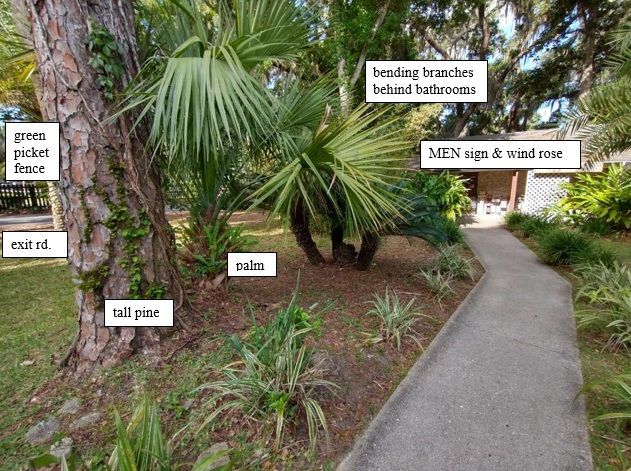
While lines 1 and 2 affirm that you are in the right place, lines 3 through 7 all speak to the location of the treasure. The “men” sign, “wind rose”, “bending branches”, and “a green picket fence”, are all near “the base of a tall tree” where the treasure is buried (see photo below).
Though the “green picket fence” is not labeled on the Park Map, it runs along the south side of the Park Exit (32 on the Park Map above) and can be seen at the left edge of the photo below.
Mystery writers often subtly introduce important elements of their story early, so that the reader will recall them later, and solve the mystery. Byron introduces the “green picket fence” here so that the reader will later recognize it when he refers to it symbolically as “the tall grass”.
7) At the base of a tall tree
This clue might not seem very helpful since there are many tall trees in the area. But later in the verse Byron provides a clue that singles out the exact tall tree.
Tall (pine) tree with MEN sign, wind rose, bending branches, & green picket fence nearby
8) You can still hear the honking
This clue refers to a bevy of swans that once lived in the park. Sadly, shortly before Byron’s visit the swans were killed by a pack of wild dogs that roamed the marsh. Because the swans were loved by visitors, the story got significant coverage in the local news.
9) Shell, limestone, silver, salt
There is a prominent shell and limestone wall between the abovementioned bathroom building and Magnolia Ave., which the “green picket fence” adjoins (see photo below).
Shell & limestone wall behind bathroom, with adjoining green picket fence

Also, a “silver, salt” cellar (salt shaker) is perhaps the most notable artifact recovered from this site, with a replica on display in the Spring House just east of the “tall tree” (see photo below).
Silver salt cellar

10) Stars move by day
11) Sails pass by night
These lines refer to the Navigator’s Planetarium building (4 on the Park Map above) where demonstrations are given on how early mariners used the stars to sail at night. Byron introduces the Planetarium building here so that the reader will recognize it a few lines later, when he uses its dome to simulate “moonlight”.
12) Even in darkness
This clue calls attention to the fact that the next clue is valid “Even in darkness”.
13) Like moonlight in teardrops
14) Over the tall grass
The fact that he starts this clue with “Like” tells us that it’s not about “moonlight,” “teardrops,” or “tall grass,” but rather things that simulate moonlight, resemble teardrops, and symbolize tall grass. The spherical white dome atop the planetarium simulates moonlight, the water droplets of the fountain resemble teardrops, and the green picket fence (behind you in the photo below) symbolizes tall grass. What’s more, this clue necessitates that you be north of the green picket fence to view “moonlight in teardrops Over the tall grass”, which narrows down where the tall tree and the treasure can be.
15) Years pass, rain falls.
This again refers to the hourglass-shaped fountain (see photo below).
Hourglass-shaped fountain with planetarium dome in the background (picture was taken with green picket fence behind you, when the fountain was not in operation)

Notice that Byron said “Over the tall grass", not 'on' the tall grass. Even in darkness, the moon-like planetarium dome lines up with the hourglass-shaped fountain, to create a vector that passes over the green picket fence and near "the base of a tall tree" (see photos above and below).
Regarding which "tall tree", this is one of three clues that have baffled most. A second baffling clue is Byron's use of "teardrops". But like everything else in Byron's puzzles, his use of "teardrops" was purposeful. Teardrops imply sadness, as in to pine. There is exactly one pine tree on the 15-acre property that comprises the park, and it is near the ‘MEN’ sign, the wind rose (old location), the green picket fence, and only inches from the abovementioned vector (see photo below).
Also, if you draw a line from the pine tree to the ‘MEN’ sign outside the bathroom, it intersects the planetarium/fountain vector at the exact location of a small palm tree. Which brings us to the third baffling clue. In the lower right corner of the painting there is a palm tree that has no reflection in the water. The reason it was painted with no reflection is to signify that it wasn’t there when Byron buried the treasure. After Byron placed the treasure in the hole, he planted a small seedling palm above it in the same hole. Think about it; bringing a small plant was the perfect pretext for having a shovel and digging a hole.
What’s more, nowhere in this puzzle are there dimensions defining the precise location of the treasure. As he did in 10 of his 11 other puzzles, Byron used an object, in this case a palm tree, to indicate the precise location of the treasure.
Vector leading to the base of the tall pine tree

General Conclusions
There are several things that indicate St. Augustine was likely the first puzzle that Byron completed.
St. Augustine is commonly called the “Nation’s Oldest City”, which would make it an ideal starting point.
The word ‘casque’ is a relatively uncommon term that was originally used to describe the silver salt cellar found in 1908 in what is currently the Fountain of Youth Archaeological Park in St. Augustine. The fact that Byron used this word in all his puzzles means that he likely came across it in the very beginning.
He planted a small seedling in the same hole he buried the treasure. He would have, no doubt, been most uneasy the first time he entered a park to dig a hole. Which means his first park would have been the most likely to receive such a plant.
He bracketed both the latitude and longitude. In the cracks of the rock in the painting can be found both 29 & 30 (for the latitude) and 81 & 82 (for the longitude). In most of his puzzles he only provided the lower number. The thought being that at some point after his first puzzle he realized that he only needed to give the base number of each.
Current Status of the St. Augustine Treasure
The St. Augustine casque is still exactly where Byron buried it, directly beneath a small sabal palm right next to a tall pine tree. This is one of two puzzles where Byron planted a seedling in the same hole, to delineate the precise location of the treasure.
Today, the small seedling that Byron planted has grown into a 6’-8’ sabal palm (cabbage palm), which will likely have to be removed if the casque is to be recovered. The complication being, as previously mentioned, this palm tree is close to the property’s only pine tree, which the proprietor would like to protect. To the best of my knowledge, management is not receptive to any digging in the vicinity of that pine tree.
If that should change, the two best ways to ensure that the pine tree is not harmed are:
Cut the palm tree down, close to the ground, and hand dig to remove its root-ball.
Use and AirSpade to dig up the palm without harming the roots of the pine tree.


