
The Roanoke Island Solution
Updated: Nov 18, 2024
Elizabethan Gardens, Roanoke Island, NC.
Image 3

Verse 11
1) Pass two friends of octave
2) In December
3) Ride the man of oz
4) To the land near the window
5) There’s a road that leads to
6) Dark forest
7) Where white is in color
8) With two maps
9) After circle and square
10) In July and August
11) A path beckons
12) To mica and driftwood
13) Under that
14) Which may be last touched
15) Or first seen standing
16) Look north at the wing
17) And dig
18) To achieve
19) By dauntless and inconquerable
20) Determination
21) Your goal.
1) Pass two friends of octave
The term “Pass” implies that we should be traveling, perhaps on a road. “two friends of octave” refers to Wilbur and Orville Wright, who were friends of Octave Chanute, the man often hailed as being the father of aviation. This clue is suggesting we pass the Wright Brothers National Memorial on the Outer Banks just south of Kill Devil Hills.
2) In December
“December” is the 12th month, signifying that we should be traveling on NC Hwy. 12 and pass by the Wright Brothers National Memorial (see photo below).
Proximity of NC Hwy. 12 to Wright Brothers National Memorial

3) Ride the man of oz
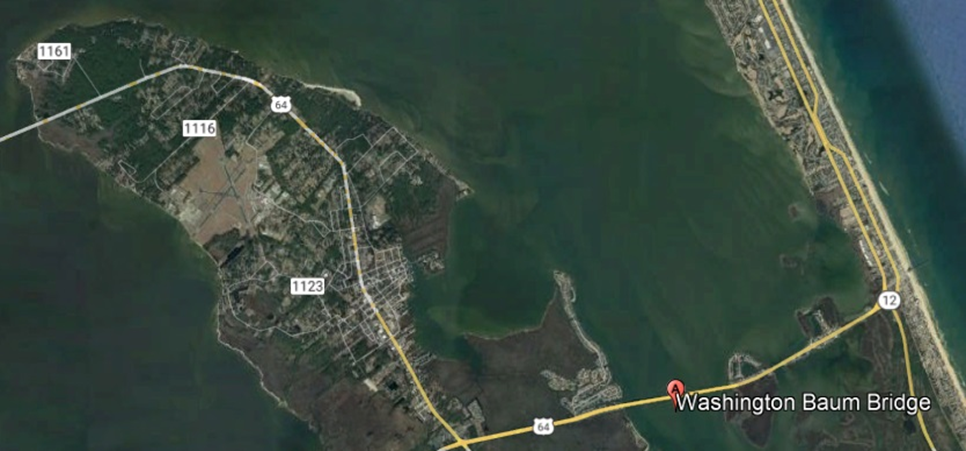
L. Frank Baum wrote The Wizard of Oz, which tells us that we should be heading south on NC Hwy. 12 until we reach U.S. Hwy. 64, at which point we should head west over the Washington Baum Bridge and onto Roanoke Island (see photo below).
NC Hwy. 12 south to U.S. Hwy. 64 west over Washington Baum Bridge
4) To the land near the window
There is an outline of Roanoke Island near the right side of the window in the painting (see image below left and map below right). This clue confirms that we should reach Roanoke Island.
Painting Map

5) There’s a road that leads to
6) Dark forest
This refers to Fort Raleigh Road, which takes you from U.S. Hwy. 64 to the Fort Raleigh National Historic Site (see bottom of image below). This is the site of the first English settlement in present-day United States. The “Dark forest” is what the settlers are said to have walked through when they abandoned the site. It’s mentioned on a Memorial Plaque at the main entrance to the Elizabethan Gardens.
Fort Raleigh map with Fort Raleigh Road at the bottom

7) Where white is in color
8) With two maps
9) After circle and square
This clue puts us just a few feet from the Waterside Theatre ticket booth, which is reached by following Fort Raleigh Road, and “After” transiting a traffic “circle” and arriving in a “square” parking lot (see image above). Here there are three information panels the center of which contains two color maps (see photo below left). One map is a historic watercolor by John White, the English artist who accompanied the failed colonizing expedition to Roanoke Island. The other is a modern map of the Fort Raleigh National Historic Site. A second match for this clue can be found in the adjacent panel, where a play on words refers to two colors. It mentions that the play (about John White) was created by Paul Green.
Information panels near theatre box office (ticket booth) 1896 Virginia Dare Monument

10) In July and August
This is a reference to the Virginia Dare Monument just a few hundred feet away (see photo above right). It has an inscription that starts with “ON THIS SITE, IN JULY – AUGUST 1585”.
11) A path beckons
12) To mica and driftwood
This clue refers to the Thomas Hariot Nature Trail, which wanders through the park and presents access to the shoreline (without going through the Elizabethan Gardens). Along the shore there is considerable driftwood and granite stones that are filled with mica. The granite stones have been placed there to minimize erosion.
13) Under that
14) Which may be last touched
15) Or first seen standing
Because it is commonly thought that the colonists’ last act before abandoning their settlement was to carve the name of the place where they were headed, in a tree, a tree is likely the last thing they touched. Also, when approaching the island, standing trees are likely the first thing they saw. But the real significance of this clue is in its hidden meaning. It refers to under a particular tree that has fallen over along the shore, hence “first seen standing”.
16) Look north at the wing
17) And dig
18) To achieve
19) By dauntless and inconquerable
20) Determination
21) Your goal.
This clue indicates that we should be somewhere along the north coast where we can look northward across the water and see the 60-foot-tall granite monument of the Wright Brothers National Memorial.
But only when these clues in the verse are combined with specific clues in the painting does this puzzle reveal its solution.
The figure in the painting is wearing Elizabethan-era body armor, which points us to the Elizabethan Gardens.
There are two bubble-like spheres to the left of the figure in the painting (see image below left). They represent the spheres atop two brick columns at the back (north side) of the Gardens. Below right is a photo of how they would have looked when Byron was there. The fact that one sphere appears larger than the other in the painting suggests not that it is bigger, but rather that it is closer. It represents the perspective from which they should be viewed.
Floating spheres in painting Twin spheres atop original columns

Twin spheres atop brick columns today, near bent tree with roots exposed (far right)

Storm surge and erosion have changed things considerably (see photo above). But notice the location of the bent tree with the exposed roots (far right) relative to the two spheres in the photo above. If you stand on this side and to the left of the left sphere, and look toward the bent tree, because you are closer to it, that left sphere would appear larger than the other, precisely the way it is portrayed in the painting.
Leather armor belt Bent tree with exposed roots

Also notice that the (red) leather straps of the armor belt in the painting (above left) are emanating downward and outward, similar to the exposed roots of the bent tree (above right).
What’s more, the pixie beneath the larger sphere in the painting (image below left) is bent backwards, much like the tree trunk (photo below right). And growing upward from the top of that tree trunk are two branches that (though they now appear dead) might have been symbolized by the pixie’s two upward reaching arms.
Plumb Bob Bent tree with two upward growing branches

I have placed a thin red circle around a faint plumb bob that shows up in the lower-left portion of the painting. It hangs from the armored figure's right elbow and appears to be directly below the flower inside the sphere and the pixie’s right arm and leg (see image above left). This likely signifies that the treasure is buried directly beneath that upward growing branch, or perhaps under an elbow of that branch that no longer exists (see photo above right).
Belt with jewel

The figure in the painting is wearing a belt with a jewel mounted to it (see image to the left). That belt represents the wall around the Elizabethan Gardens, and the jewel's position tells us that it is located outside of that wall along a section that dips down. Because the northern boundary of the Gardens is a coastline, that section of the wall consists of a chain-link fence that dips down about six to eight feet to reach the elevation of the shore. (A damaged portion of that chain-link fence can be seen in the lower-right area of the photo above.) This clue tells us that the treasure is buried outside the Elizabethan Gardens' wall, somewhere along the shoreline.
Current Status of the Roanoke Island Treasure
Even though this casque is located along the north shore of the Island, which has suffered several significant weather events, because Byron chose a location that had some local protection from the open water, there is a reasonable chance that this casque still exists exactly where he buried it. Unfortunately, because the landmarks he used are rapidly deteriorating and disappearing, even if the casque does remain, its exact location could soon be lost forever.


