
The Montreal Solution
- Nov 14, 2024
- 7 min read
Updated: Nov 19, 2024
Parc du Faubourg-Sainte-Anne, Griffintown, Montreal, QC.
Image 9

Verse 5
1) Lane
2) Two twenty two
3) You’ll see an arc of lights
4) Weight and roots extended
5) Together saved the site
6) Of granite walls
7) Wind swept halls
8) Citadel in the night
9) A wingless bird ascended
10) Born of ancient dreams of flight
11) Beneath the only standing member
12) Of a forest
13) To the south
14) White stone closest
15) At twelve paces
16) From the west side
17) Get permission
18) To dig out.
A great many of Byron’s clues have multiple meanings. Often, one referred to a prominent local venue that he thought was worth experiencing, and the other took you closer to the treasure. This is precisely the case with the first three clues in Verse 5.
1) Lane
The first reference of this clue is to Montreal’s Formula 1 racetrack, Circuit Gilles Villeneuve, on Notre Dame Island about a mile northeast of Griffintown (see photo below). The racetrack was completed in 1978 just a few years prior to Byron’s visit. Its shape can be seen in the outline of the man’s smile in the painting.
Griffintown and Circuit Gilles Villeneuve

The second reference is to a street that passes just a few feet from the treasure. The connection here can be found in the definition of lane, a narrow road. Parc du Faubourg-Sainte-Anne (St. Ann’s Park) in Griffintown is triangular in shape and bounded by three streets. But only the street on its southwest side, Rue Rioux, is one-way and thereby narrower than the other two (see photo below).
Parc du Faubourg-Sainte-Anne (St. Ann’s Park) in Griffintown

Note that in the northeast corner of the park you can still see the granite foundation of St. Anne’s Church, for which the park is named.
2) Two twenty two
This clue builds on the two things referenced in the first clue.
222 Circuit Gilles Villeneuve is the address of the abovementioned Formula 1 racetrack.
Also, when measured along Rue Rioux from the street sign that bears its name, in the direction of its (one-way) traffic, “Two [hundred] twenty two” [feet] is the exact distance to where the treasure is buried (see photos below left and right).
But several things have changed in the last few years. There used to be a kind of multipurpose utility pole at the northwest end of Rue Rioux, which held a street sign bearing its name (see photo of old pole below left). Now, the one-way traffic has been rerouted in the opposite direction and that street sign has been moved. But when Byron was there, 222 feet measured from the old street sign in the old direction of traffic was where you would find the next clue, “You’ll see an arc of lights”. It’s difficult to discern in the photo, but the location of the street sign can be determined by the shadow of the pole to which it was attached (see photo below right).
Old street sign location 222-foot measurement from street sign

3) You’ll see an arc of lights
While there may also be an arc of lights that can be seen from the racetrack, this clue most certainly refers to the arc of light-colored granite stones that are located in St. Ann’s Park just a few feet from the abovementioned “Lane” and “Two [hundred] twenty two” [feet] from the sign that bears its name (see photo above right).
4) Weight and roots extended
5) Together saved the site
6) Of granite walls
These lines refer to the “Weight and roots” of the Griffintown community, who “Together saved the site Of granite walls” of the St. Ann’s Church, which can still be seen in the northeast corner of the park.
7) Wind swept halls
This clue is another reference to Notre Dame Island, which was the site of the 1967 World’s Fair and the 1976 Summer Olympics’ rowing and canoeing. Notice both the numbers 67 and 76 in the flower in the painting (see image below). Though the site remained open to the public in the summertime until 1984, by the time Byron arrived in 1981/82 many of the pavilions had deteriorated and were abandoned, hence the “Wind swept halls”.
Flower with 67 & 76

8) Citadel in the night
This refers to the Salvation Army Citadel, which provided shelter to those in need day or night. It was located in the Golden Square Mile area (see photo below) of Montreal from 1948-2007, less than a mile northwest of St. Ann’s Park. It was also just a few hundred feet from the George Stephen House, which is where you can find the ‘leg-eater-dog’ shown in the painting.
Golden Square Mile Area

Leg-eater-dog in painting Leg-eater-dog lamp base at George Stephen House
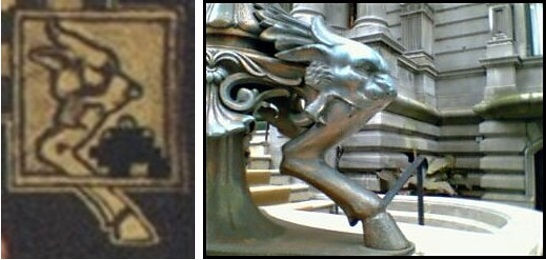
9) A wingless bird ascended
10) Born of ancient dreams of flight
This refers to Canada’s first ever passenger flight, which was conducted on Sep. 8, 1856, by a hot-air balloon called Canada. It took off from Griffintown just a few hundred yards north of present-day St. Ann’s Park.
11) Beneath the only standing member
12) Of a forest
This clue is classic Byron. He used his literary expertise to take advantage of our natural propensity to misread what is written. Upon reading this clue virtually everyone envisions a sole surviving tree where a forest once stood. But that’s not what it says. It doesn’t say ‘the only member still standing’; it says “the only standing member”. While shrubs, vines, grasses, and mosses are all members of a forest, the only such member that is commonly referred to as standing is a tree. The treasure is buried beneath a tree.
13) To the south
Like many other lines in Byron's puzzles, this line is applicable to both the clues above it and below it. The tree beneath which the treasure is buried is south of where the hot-air balloon Canada took off. And the “White stone” is not only south of that tree, but the southernmost of the four white stones (see photo below).
14) White stone closest
15) At twelve paces
16) From the west side
When Byron used the terms “paces” or “steps”, he used them not as a means of exact measurement, but rather as an approximate distance to a particular object, which in turn would define the exact location of the treasure. Byron equated the terms “paces” and “steps” to the generally accepted approximate distance of 2.5 feet (30 inches). In this case, “twelve paces”, or approximately 30 feet, brought you to a “White stone”, which revealed the location of the treasure.
Byron refers “To the south White stone closest At twelve paces From the west side”. The question is from the west side of what? This is another of Byron’s multi-clues. It refers to both the west side of the park and to the west side of closest white stone. The photo below is what it looked like when Byron was there. Notice that there is no sidewalk, just a dirt path in the park alongside the curb, which means that Byron would have measured those “twelve paces” (30’) from the concrete curb, to the west side of the southernmost white stone (see photo below, which was taken facing north).
Arc of light-colored stones 12 paces from the west side of the park, 222 feet from Rue Rioux street sign

Among the things that have recently changed is a new 7.5’ wide sidewalk (see photos below). Fortunately, the four light-colored stones (to the right in these photos) and the utility pole (to the left in these photos) were not moved. Which makes it possible to still take accurate measurements. The new sidewalk encroaches 2.5’ (1 pace) into the park and 5’ into the street, which can best be seen at the base of the utility pole in the photos below. Now, the south white stone “From the west side” [of the park] has been reduced from 30’ to 27.5’ (from 12 paces to 11 paces).
Before sidewalk

After sidewalk

17) Get permission
18) To dig out.
On the surface this clue appears to be of little consequence. But it’s safe to say that none of Byron’s clues were purposeless. This is the only puzzle in which Byron mentions getting permission to dig. Also, if you wanted to remind people to get such permission, the most likely wording (in descending order) would be:
a) Get permission to dig
b) Get permission to dig up
c) Get permission to dig out
Intrinsic to this last clue is the question ‘out from where?’ The most likely answer is out from between the two most southern white stones. This location is on the west side of the southernmost white stone. Notice the gap between the last two stones (lower left photo) and how the jewel in the painting is located between the last two of four light-colored rectangles in a diagonal row on the man’s hat (lower right image). As is often the case, the last few lines of the verse delineate the precise location of the treasure.
Arc of light-colored (granite) stones Jewel tucked in between lower two rectangles on hat

Current Status of the Montreal Treasure
The Montreal casque is still exactly where Byron buried it. The possible difficulty being he may have buried it three to three and a half feet down. In the book Byron states that the casques are buried at a depth of no more than three to three and a half feet. Which begs the question why would any casque need to be buried so deep? The Montreal casque may answer that question. If there's one thing we've learned about Byron and his puzzles, it's that there isn't much he didn't think of. Byron may have buried the Montreal casque deeper than all the others out of concern for the ground freezing and crushing the plexiglass box.


